Midas Announces the OTC Liquidator Network with $500M+ of Capacity, as Part of the Open Liquidity Architecture
Most tokenised products inherit the settlement timelines of their underlying assets. A redemption waits for the next NAV, which can take days or weeks. Onchain markets run continuously.
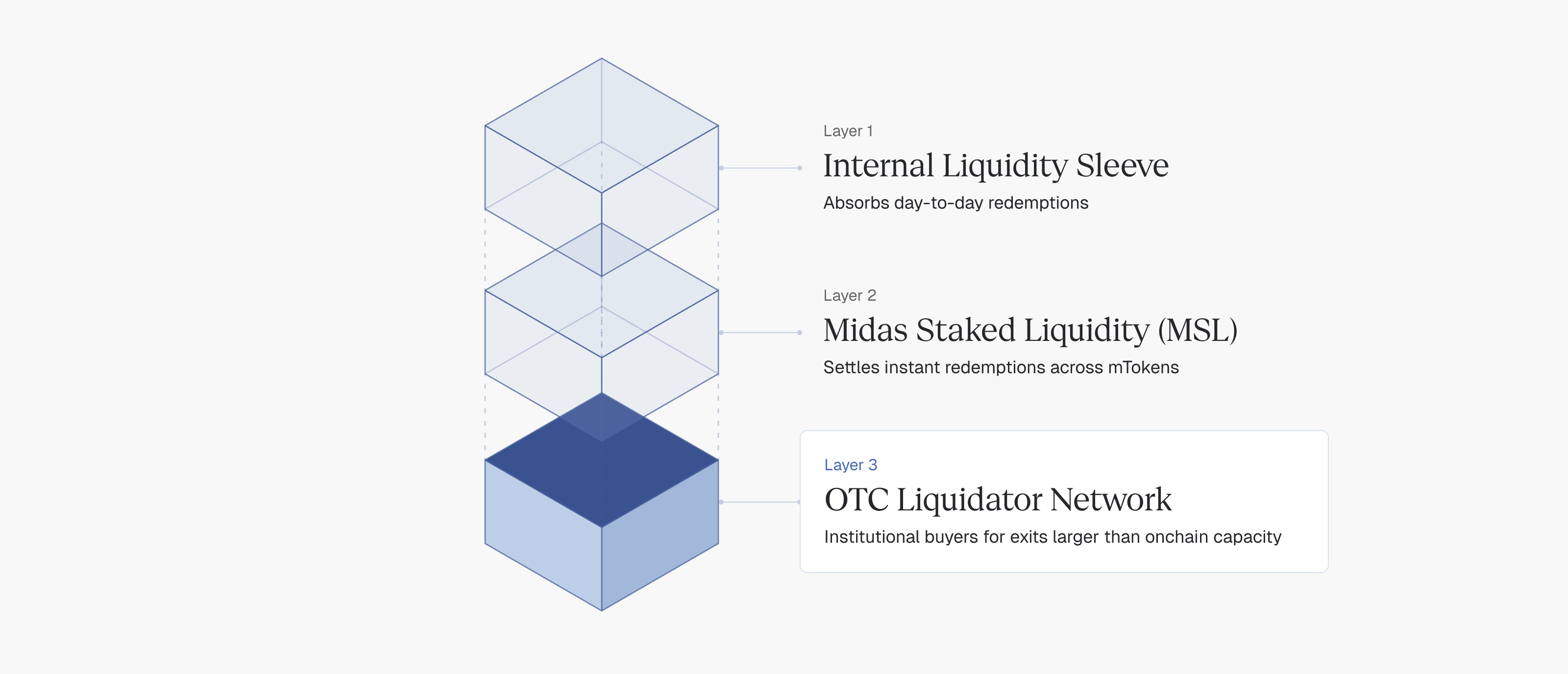
The Open Liquidity Architecture is how Midas closes that gap. Liquidity comes from three layers of capital, each sized for a different kind of exit:
- Layer 1, Internal Liquidity Sleeve. A small, highly liquid share of selected portfolios absorbs day-to-day redemptions, accessed atomically through protocols such as Aave and Morpho.
- Layer 2, Midas Staked Liquidity (MSL). A shared pool settles instant redemptions across mTokens in a single transaction, so portfolios do not need to hold idle cash.
- Layer 3, OTC Liquidator Network. Institutional counterparties buy mTokens directly when an exit is larger than onchain capacity.
The liquidity page shows the architecture and the instant redemption capacity of each mToken. The docs cover the redemption mechanics in detail.
This post covers the third layer: the OTC Liquidator Network. The $500M+ figure is the capacity Midas is targeting as more firms join, not capacity committed at launch.
Why a Third Layer
Instant redemption capacity is finite by design. Holding enough idle capital to cover every possible exit at once would create cash drag across every portfolio.
Some exits are larger than what the first two layers hold at a given moment. A large holder may want to exit a position in one go. A lending market may need to liquidate a sizeable mToken position on a borrower's loan.
Standard redemption stays available in every case. It follows each product's NAV cycle, which can take several days depending on the strategy. The liquidator network is there for exits that need to happen sooner and at size.
How It Works
The network is a group of institutional counterparties that have agreed to buy mTokens directly from holders, each on a defined set of products.
When a redemption exceeds available instant capacity, the holder sells the mTokens to a network counterparty in a direct OTC trade and receives USDC. The counterparty then redeems through the standard process at the next NAV. Price and size are agreed between the two sides.
Lending markets follow the same logic. When a position backed by mTokens is liquidated, a liquidator acquires the mTokens at a discount and redeems them through the standard process. Before listing an mToken as collateral, curators want to know who will take the other side of that trade. The network answers that question by name.
Who Is in the Network
The network currently includes 12+ counterparties. Each brings its own balance sheet and risk appetite, so coverage does not rest on a single desk.
- Keyrock. Digital asset market maker founded in Brussels in 2017, active across market making, OTC and options. keyrock.com · X
- Symbiotic. Collateral markets platform whose Liquid Lane routes redemption requests to competing market makers through RFQ. Midas was the first issuer on Liquid Lane. symbiotic.fi · X
- RedStone. Infrastructure company providing market data, risk intelligence through Credora, and liquidity infrastructure for tokenised assets. Its RedStone Settle product gives holders of tokenised assets an exit path beyond the standard redemption cycle. redstone.finance · X · LinkedIn
- Fission. New York firm building liquidity infrastructure that lets investors sell tokenised fund shares without waiting for the redemption cycle. fission.xyz · X
- Octarine. RFQ venue where holders of tokenised RWAs exit instantly onchain by taking the best of competing bids, priced against NAV. It also acts as a liquidator of last resort in DeFi lending markets. octarine.finance · X
- Amber Group. Digital asset firm founded in 2017, providing trading, liquidity and wealth management services to institutions and high-net-worth investors. ambergroup.io · LinkedIn
- Third Eye. Liquid crypto fund taking high-conviction positions across digital assets and crypto equities. third-eye.co · X
- Alphaparty. Digital asset firm trading price dislocations across liquid markets. alphaparty.io
- Multiliquid. Founded by former Standard Chartered and UniCredit executives, Multiliquid positions itself as an institutional liquidity protocol for tokenised assets. multiliquid.xyz
- Odl. RWA platform that lets liquidator funds buy tokenised assets at a discount and resell them to traditional buyers. rwaodl.com · X
- kpk. Formerly karpatkey, kpk has run onchain treasury operations for organisations such as Gnosis and ENS since 2020 and curates lending markets on Morpho and Gearbox. kpk.io · X
- Atomic Digital. Market-neutral, multi-strategy hedge fund active in quantitative trading, OTC structured products and DeFi. atomic-digital.org · X · LinkedIn
Open by Design
Any qualified counterparty can join the network. Each one adds capacity, and more counterparties quoting on each trade means more competitive pricing for holders. The network launches with 12+ counterparties, and Midas is targeting $500M+ of capacity as more firms join.
How the Layers Work Together
Layers 1 and 2 settle onchain in a single transaction. Layer 3 extends capacity beyond them through direct relationships with institutional counterparties. Together they give holders a route out at any size, with no single source of capital carrying the full load.
Tokenisation solved issuance first. Whether onchain investment products can scale depends on what happens at the exit, and that is what the Open Liquidity Architecture is built for.
As the product range grows, so does the network. See the architecture and the instant redemption capacity of each mToken at midas.app/liquidity.
About Midas
Midas is a platform for composable onchain investment products. It gives investors exposure to institutional strategies, run by professional strategy managers, through its performance-linked mTokens. These tokens offer full transparency, instant redemptions, and native composability across DeFi.
Founded in 2024 by Dennis Dinkelmeyer (formerly Goldman Sachs), Fabrice Grinda (FJ Labs), and Romain Bourgois (formerly Ondo Finance), Midas is backed by leading investors including RRE, Creandum, Framework Ventures, HV Capital, Ledger Cathay and Coinbase Ventures. The company recently secured $50M in Series A funding, building on a track record that includes over $4B in asset issuance and $48M in yield paid out to date.