White-Label Vaults: How to Launch Your Own Onchain Vault
White-label vaults let a company launch an onchain vault under its own brand while another provider builds and runs the infrastructure underneath. The brand owns the product and the user relationship. The infrastructure provider supplies the technology and operations: smart contracts, oracle pricing and redemption processing.
Wallets, exchanges, card issuers and DeFi protocols use them to offer onchain strategies to their users without hiring a smart contract team or building a vault stack from scratch.
This guide covers what a white-label vault is, what sits inside the stack, when to build instead, and how teams launch on Midas White-Label Vaults.
What Is a White-Label Vault?
A vault is a set of smart contracts that accepts assets from users, issues them a token representing their share, and puts the pooled assets to work in a defined strategy. When users redeem, they hand back the token and receive assets at the current share price.
A white-label vault is the same system, built and maintained by an infrastructure provider and launched under another company's name. The user sees the partner's brand, interface and product terms. The provider stays in the background.
The model is familiar from traditional finance, where banks and fintechs distribute products built on someone else's rails. Onchain, it solves a specific problem. Vault infrastructure is hard to build well, and most companies that want to offer a vault are distribution businesses, not smart contract teams.
Who Uses White-Label Vaults
Any business with users and balances can run a white-label vault. Four groups account for most of the demand.
Wallets and card issuers. Balances sitting in a wallet or card account can be offered an investment option inside the same app. Ether.fi runs Midas-powered vaults behind its own products.
Exchanges and neobanks. A branded vault gives users an onchain strategy without the platform building or auditing contracts itself. Platforms that would rather offer ready-made products can use Embedded Investing instead.
DeFi protocols. Protocols launch vaults around their own ecosystem to give users a simple way in and to keep capital working inside it.
Curators and strategy teams. Teams with a strategy but no infrastructure can run it through a vault under their own name.
What's Inside a White-Label Vault Stack
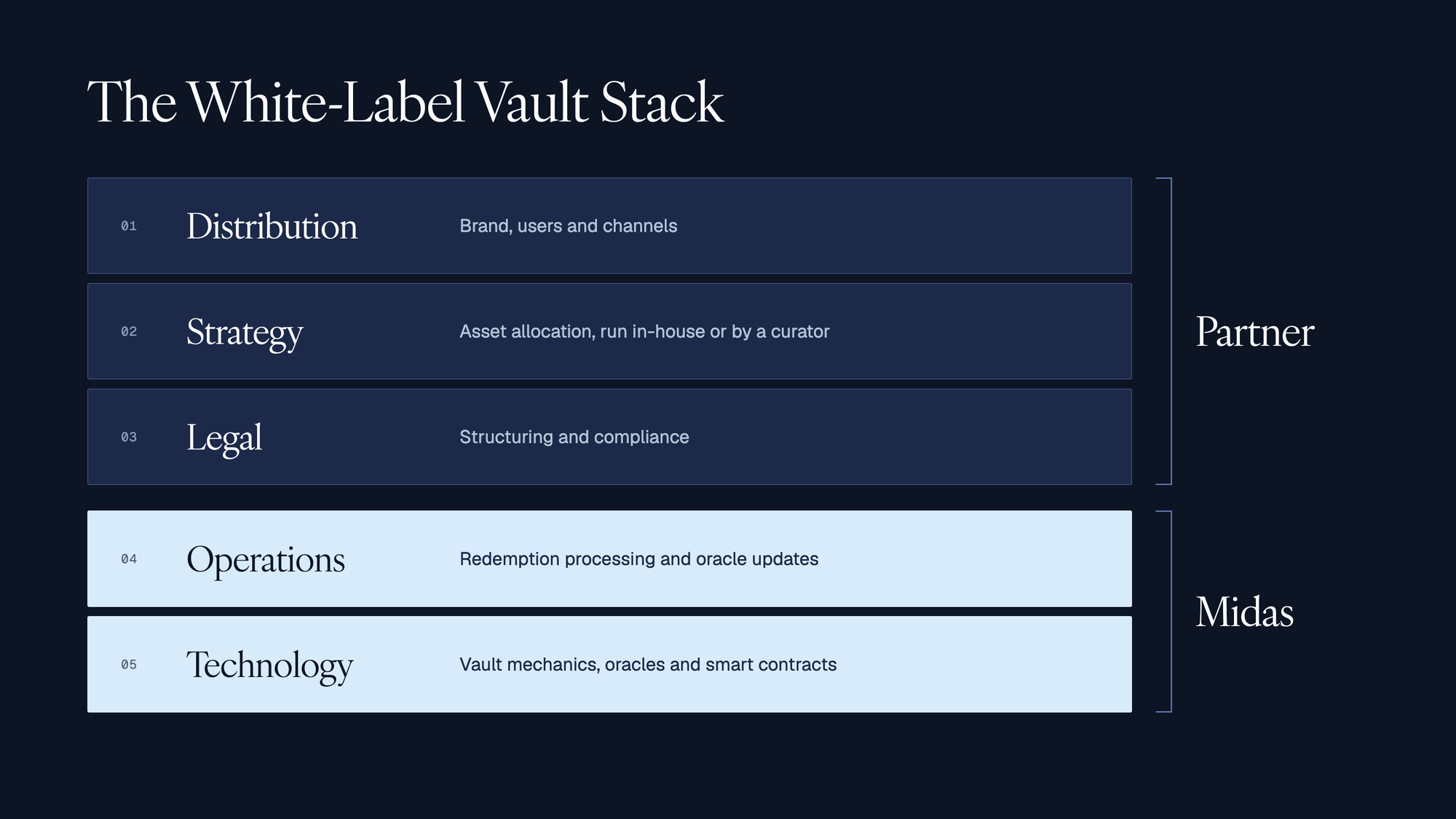
A white-label vault sits on five layers. The partner owns the top three. With Midas White-Label Vaults, Midas runs the bottom two as one module: pre-built, audited and operated.
Four Smart Contracts
The technology layer is four smart contracts, each configured to the partner's product.
- Receipt token. A standard ERC-20 token, usable across DeFi and CeFi. Denomination, token and vault names, chains and an optional whitelist for permissioned products are all configurable.
- Oracle. A NAV-based price feed, or a constant-growth feed with adjustable growth. Update frequency follows the strategy's return levels and volatility.
- Issuance vault. Takes assets in and mints receipt tokens. Accepted assets, oracle ranges, minting caps and maximum capacity are configurable.
- Redemption vault. Burns receipt tokens and returns assets, in one asset or several, within set oracle ranges.
An optional module adds on-demand redemptions to the redemption vault, with configurable limits and fees, always subject to available liquidity. The contracts run on EVM chains and Solana.
Each contract needs engineering, audits, configuration and someone running it day to day. That is the work Midas takes off the partner's plate.
Build In-House or White-Label?
Building a vault stack in-house gives full control, at the cost of a team, audits and ongoing operations. White-labelling trades some of that control for infrastructure that is already running in production.
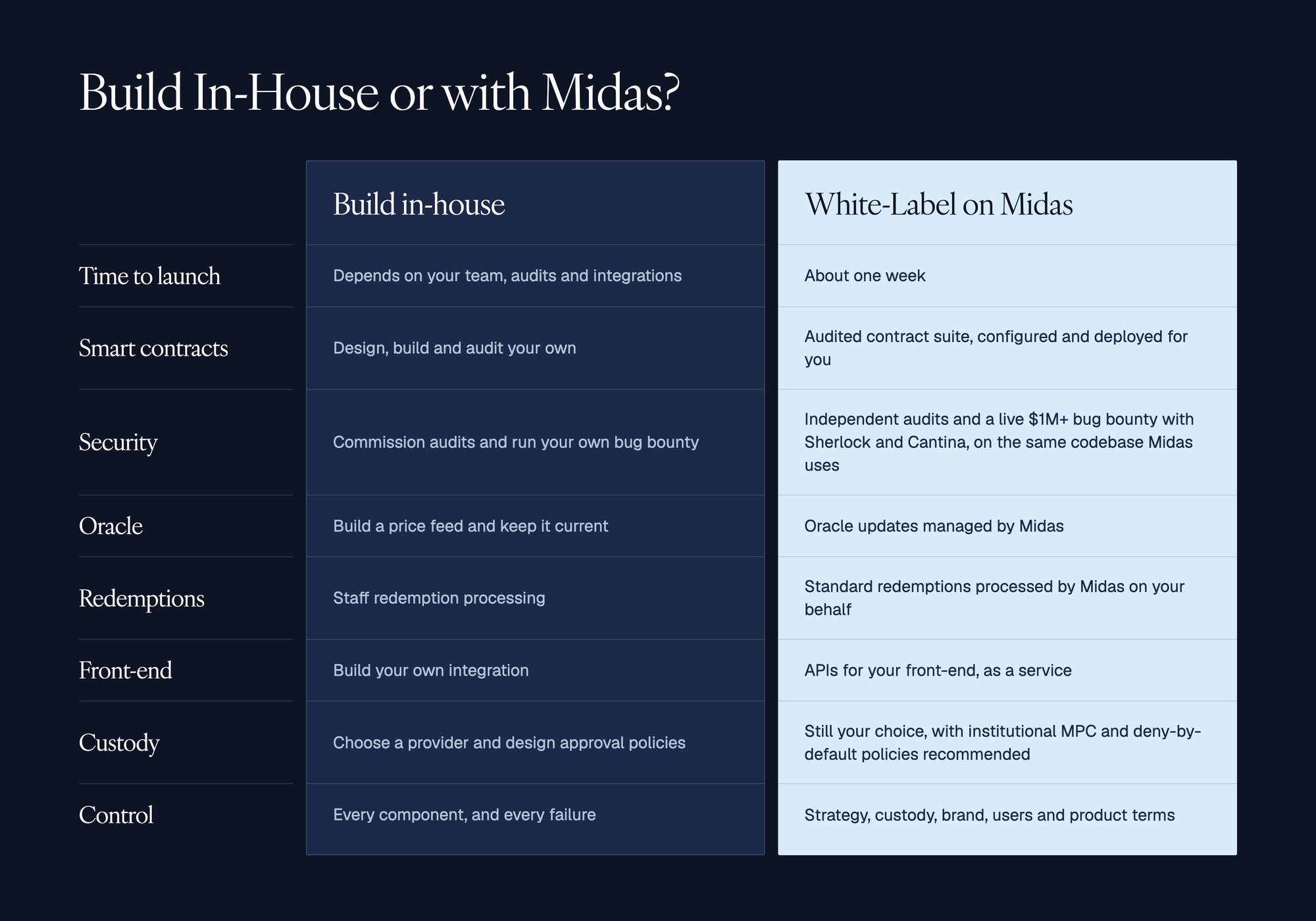
Building makes sense when the vault infrastructure is your product. When your edge is distribution, a user base or a strategy, white-labelling keeps the team on that edge.
How Midas White-Label Vaults Work
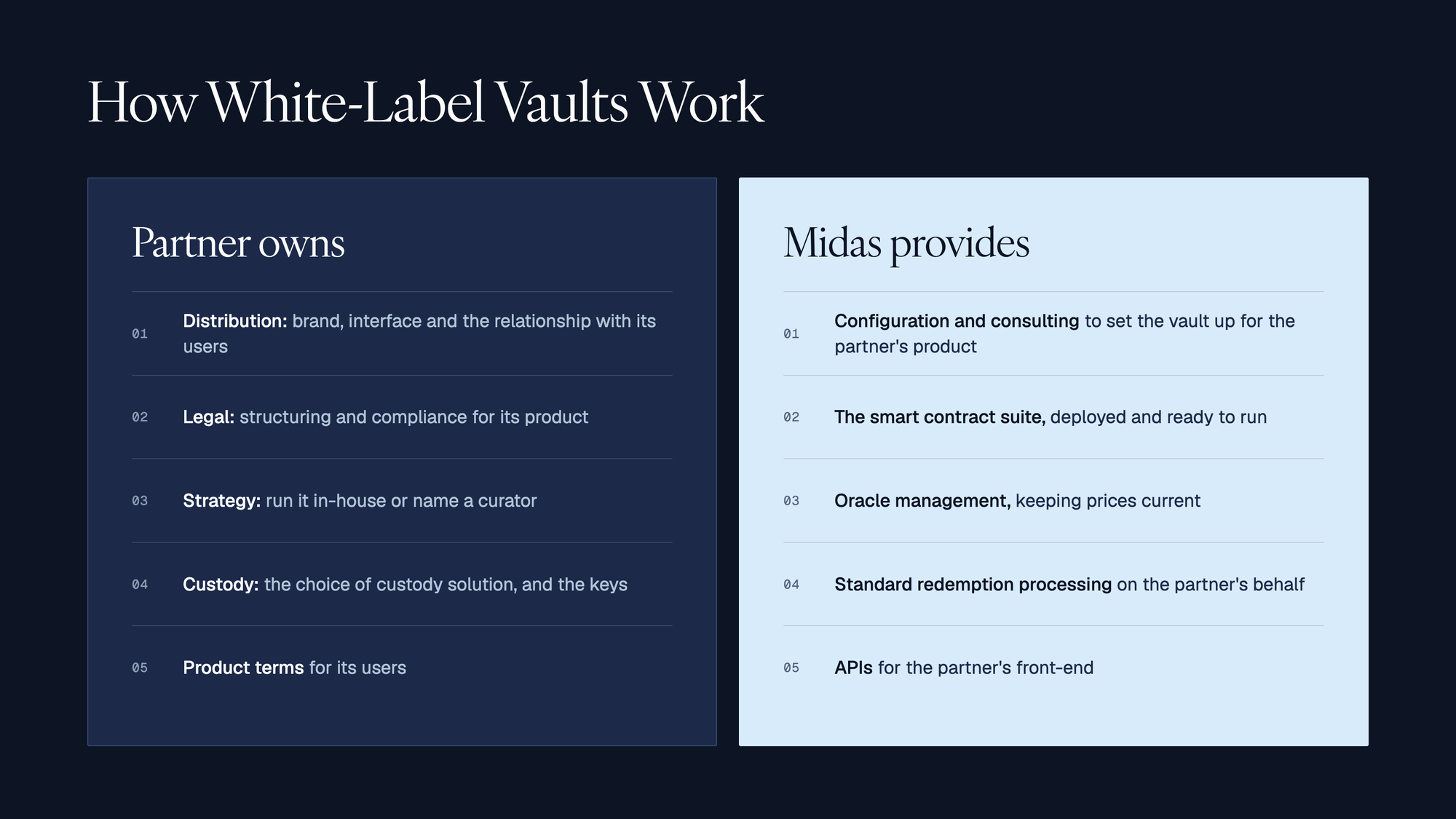
Midas White-Label Vaults are vault infrastructure that partners launch and run under their own brand. Midas is the infrastructure provider. The partner operates the product.
Strategy from the partner's own wallet. The strategy runs directly from the partner's MPC wallet, so there are no custom smart contract adapters to build or audit. The wallet can operate across EVM chains and Solana under the partner's own policies. Midas recommends Fordefi's institutional MPC, whose multi-approver whitelisting starts from deny-by-default: no action runs until it has been authorised.
Same codebase, separate product. White-Label Vaults are deployed from the same audited codebase Midas runs its own products on, covered by the same audits and bug bounty. Each deployment belongs to the partner, and Midas does not act as issuer. Investors in a white-label vault hold the partner's product, on the partner's terms. Redemption speed depends on the liquidity of the vault's strategy and on whether the optional on-demand redemption module is switched on.
mTokens inside a vault. A partner's vault can hold Midas mTokens as part of its strategy, so a branded product can sit on top of Midas's own onchain investment products.
If you would rather bring a fund onchain with Midas as issuer, that is the Tokenisation Program, covered in our guide to tokenisation.
In Practice: Ether.fi, Terminal and Turtle
Three partners run Midas-powered vaults under their own brands today.
- Ether.fi. Midas powers three Ether.fi vaults: Liquid RWA, launched with Plume in June 2026 and now at $30M+, weEUR and Liquid Reserve.
- Terminal. A custom strategy built for liquidity, running on Midas infrastructure, which scaled to $200M at its peak.
- Turtle. Midas powers vaults for Turtle, a DeFi distribution venue with over 400,000 active wallets.
In each case the partner's name is on the product, and Midas runs the technology and operations underneath it.
Launching a White-Label Vault
A launch on Midas runs in three stages.
- Scope. Define the strategy, who runs it (your team or a named curator), the assets users will invest with, the chains you need and who your users are.
- Deploy and configure. Midas configures the vault to your product and deploys the contract suite. You choose your custody setup, set product terms and connect your front-end through Midas's APIs.
- Operate and grow. Go live under your brand. Midas manages oracle updates and processes standard redemptions, while you add strategies, chains or integrations as demand grows.
A vault typically goes live in about a week, depending on the strategy and the integrations involved. Talk to the Midas team to scope yours.
Frequently Asked Questions
What is a white-label vault?
A white-label vault is an onchain vault launched under one company's brand on infrastructure built and maintained by another. The brand owns the product, the strategy and the user relationship. The infrastructure provider supplies the technology and operations: smart contracts, oracle pricing and redemption processing.
How is a white-label vault different from a lending vault?
A lending vault allocates assets across lending markets within one protocol's rules, and the curator works inside that protocol's framework. A white-label vault runs on dedicated contracts and custody built for the partner, so its strategy, permissions and product terms are set for that partner's product.
Who controls the assets in a white-label vault?
The partner does. With Midas White-Label Vaults, the partner chooses the custody solution for the underlying assets, holds the keys, and either runs the strategy itself or names a curator. Midas recommends institutional MPC custody with multi-approver, deny-by-default whitelisting policies.
Is a white-label vault the same as an onchain investment product?
No. An onchain investment product issued through Midas is a financial instrument with offering documentation and Midas as issuer. A white-label vault is infrastructure the partner runs under its own brand and terms. Read more on the difference.
What can a white-label vault invest in?
That depends on the strategy the partner or its curator defines. Because the strategy runs from the partner's own MPC wallet, it does not depend on custom smart contract adapters for each protocol. It can also hold Midas mTokens. Midas-powered vaults running today include real-world asset and hedge fund strategies.
How long does it take to launch a white-label vault?
With Midas White-Label Vaults, about one week from scoping to going live, depending on the strategy and the integrations involved.
Which chains do Midas White-Label Vaults support?
EVM chains and Solana. The receipt token can be deployed on one chain or across several EVM chains.
Launch Your Own Vault
If you have users, a strategy or both, the infrastructure already exists, and a vault can be live in about a week. Build with Midas and talk to the team about launching a vault under your brand.
About Midas
Midas is a platform for composable onchain investment products. It gives investors exposure to institutional strategies, run by professional strategy managers, through its performance-linked mTokens. These tokens offer full transparency, instant redemptions, and native composability across DeFi. Midas has raised a $50M Series A and, to date, has powered over $4B in asset issuance and paid out $48M in yield.