Proof of Reserve for mWIN: The Midas Attestation Engine in Action
The Midas Attestation Engine turns claims made by third parties into cryptographic proofs that anyone can check. Each proof shows where the data came from and that Midas did not change it. For mWIN, the engine now applies this to proof of reserve, using the portfolio statement issued by Northern Trust, custodian of the underlying assets.
How the Attestation Engine Works
Every attestation moves through three stages:
Claims. A claim is a structured piece of data from a known source. It might be a NAV figure from a strategy administrator, a portfolio statement from a custodian, or a disclosure sent by notarised email. Claims can also come from APIs and blockchain endpoints. If the data matters to investors, it can be formalised as a claim.
Attestations. Related claims are bundled into an attestation, with timestamps and predefined validation logic. The attestation is built and published through the Chainlink Runtime Environment (CRE) and stored permanently on IPFS, with its fingerprint recorded onchain. The result is a checkpoint that cannot be edited afterwards, and that investors, integrators and risk frameworks can read programmatically.
Verification. After publication, independent verifiers re-check each attestation against the original source material. They confirm onchain that the data came from an approved source, that the publication process was followed, and that Midas did not alter the data at any point. Each verification is permanently tied to its attestation.
Read more in the Midas Attestation Engine docs.
Proof of Reserves for mWIN
Most of mWIN's reserve is held with the custodian, and the rest sits onchain. The custody figure now enters the engine as a claim in its own right: Northern Trust's portfolio statement, notarised as it is sent, with proof that nothing in it was changed. The engine combines it with the onchain holdings and checks the total against the value of all mWIN in circulation. Independent verifiers then confirm the result onchain.
The valuation still comes from the custodian, but Midas is no longer in the trust path. Anyone can re-run every step without asking us for anything.
Step by Step: From Custody Statement to Onchain Proof
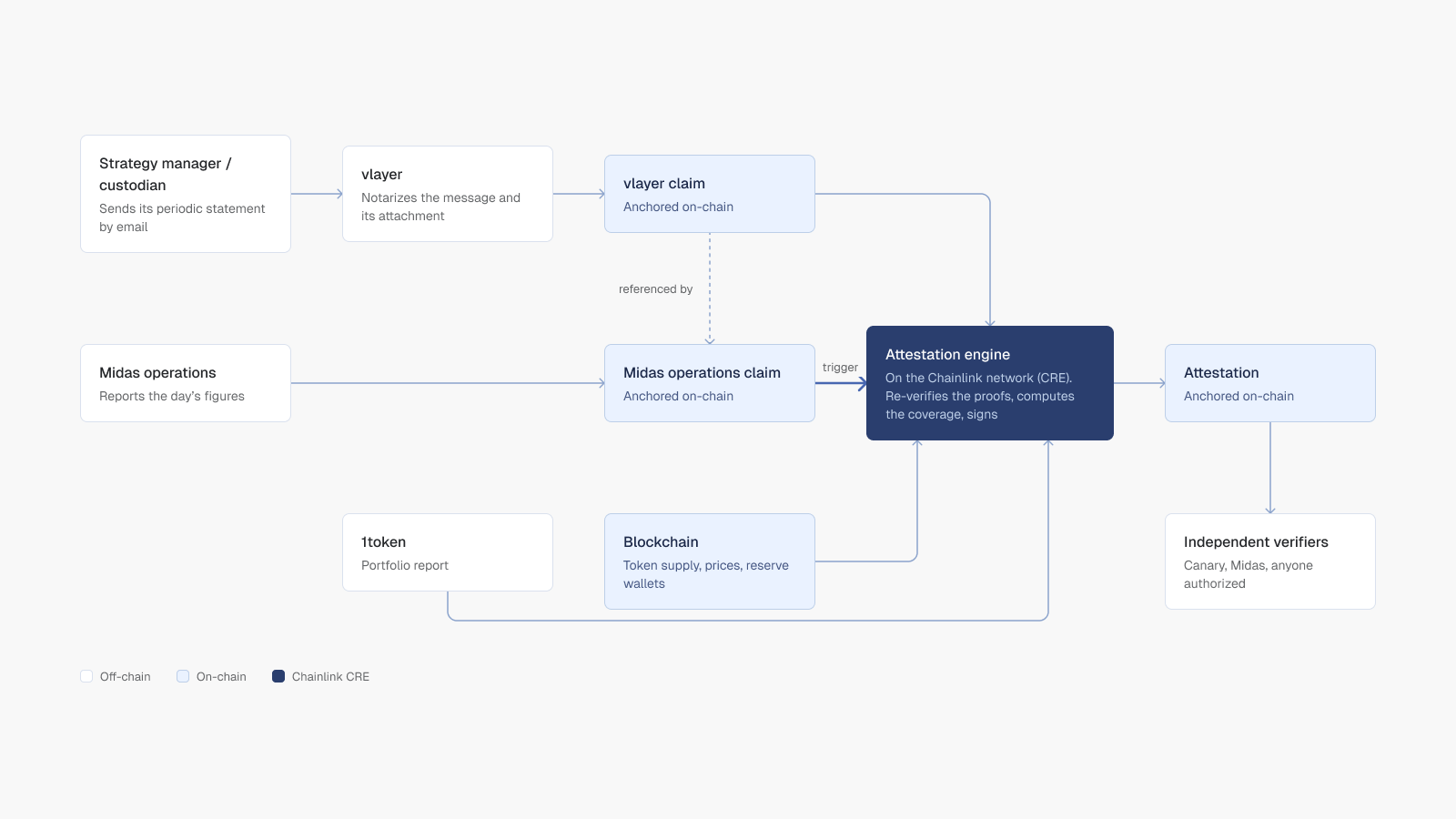
- The custodian sends its statement. Northern Trust sends its regular portfolio statement in the normal course of custody. A notarisation service, vlayer, is one of the recipients.
- vlayer notarises it. vlayer produces a cryptographic proof of the email and its attachment. The proof shows who sent it, because it is tied to Northern Trust's own mail servers. It shows who received it, because the notarisation address has to appear on the original message, which rules out forwarded copies. And it covers the content, so changing a single figure breaks the proof. All of this happens before Midas touches the data. We can reference the proof, but we cannot produce or alter it.
- Midas starts the run. Every business day, the Midas operations team publishes the day's figures onchain, referencing the notarised proof. This is the only manual step in the chain, and it only starts the process.
- The attestation engine checks coverage. The engine runs on the Chainlink Runtime Environment (CRE). Nothing is handed to it: it fetches every input itself, from the notarised statement to the onchain holdings, token supply and price. Several independent nodes must retrieve identical figures before a value is accepted. The engine then calculates coverage, signs the result and publishes it to IPFS, with its fingerprint written onchain. Edit one character of the file and it no longer matches the record.
- Verifiers re-check the work. Canary re-runs the checks on its own infrastructure, under its own keys, and re-verifies the notarised proof against the notary instead of taking the engine's word for it. Midas runs a verifier too, with no special standing. A verifier publishes only when every check passes, so a verification on the record means every check passed.
mWIN: The 28 September Attestation
Here is an mWIN attestation based on Northern Trust's statement dated 28 September.
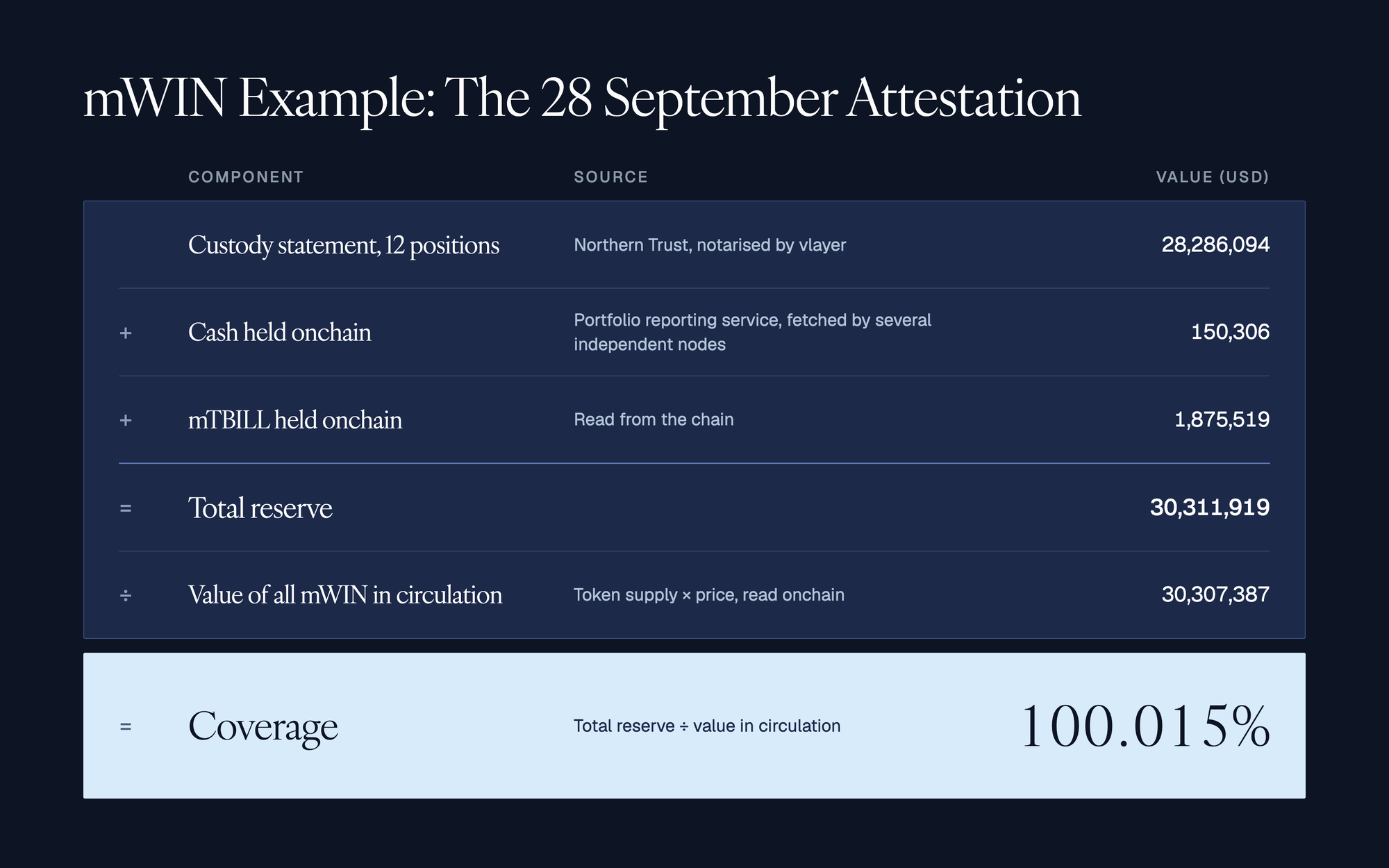
The token supply and price used are recorded inside the attestation, so the calculation can be redone exactly as it was performed. The reserve is broken down by source and the parts add up to the total. The full file is public, linked below.
What It Proves and What It Does Not
Not every input carries the same weight, and the system does not pretend otherwise.
Token supply, price and onchain holdings can be recomputed by anyone from the blockchain. Same query, same number. The rest of the onchain holdings come from a portfolio reporting service. Several independent nodes must retrieve the same figures, which removes Midas from the equation, though not the data provider.
The notarised statement proves provenance: the figure came from Northern Trust's report and was not altered on the way. It does not prove the valuation itself, which remains the custodian's responsibility. Northern Trust's role is unchanged. It issues its standard custody statement and has not reviewed or endorsed the attestation process.
Two guardrails sit on top. If coverage cannot be established above the required level, no attestation is published, so a missing attestation is itself a signal. A reserve implausibly larger than the value in circulation is treated as a measurement error.
Each statement counts for the date it describes, not the day it arrives. If money has moved since, the statement is set aside rather than used.
Check It Yourself
Everything above is public.
- Attestation file on IPFS: CID QmbuUrtB6qGkLbJGPzCLWy2TSqKWaNeKNggdF8qgPYkWJB [link: gateway URL TBC]
- Attestation Engine contract on Ethereum: 0x2D6e9F608807436DE5D9603B00Abe3FEd1Bc809d [link: Etherscan]
- Workflow and verification scripts, with a step-by-step audit guide, on the Midas GitHub [link TBC]
- The rules for each token, meaning which sources and which checks, sit in a public configuration file. Changing them takes a reviewed pull request.
- How the engine works: Midas Attestation Engine docs
The Midas Attestation Engine is built with Chainlink, LlamaRisk, vlayer and Canary. LlamaRisk co-developed the verification framework and the core attestation architecture.
Beyond mWIN
Nothing in this process is specific to Northern Trust or to mWIN. A statement from any custodian or administrator can be notarised the same way, once a notarisation address is among its recipients. Products whose portfolio sits entirely onchain need no statement at all.
Independent onchain verification is being rolled out progressively across Midas products. The aim is that every figure behind a Midas product can be checked by someone who does not work at Midas. For mWIN, that now includes the part held offchain.
About Midas
Midas is a platform for composable onchain investment products. It gives investors exposure to institutional strategies, run by professional strategy managers, through its performance-linked mTokens. These tokens offer full transparency, instant redemptions, and native composability across DeFi.
Founded in 2024 by Dennis Dinkelmeyer (formerly Goldman Sachs), Fabrice Grinda (FJ Labs), and Romain Bourgois (formerly Ondo Finance), Midas is backed by leading investors including RRE, Creandum, Framework Ventures, HV Capital, Ledger Cathay and Coinbase Ventures. The company recently secured $50M in Series A funding, building on a track record that includes over $4B in asset issuance and $48M in yield paid out to date.