mWIN: A Home for Treasury Runway

Onchain treasuries, from DAOs to protocols, typically hold their reserves in one of two places: their own token, or money market products. Diversifying out of a concentrated token position into stable, income-generating reserves is now standard practice across crypto, a deliberate and well-understood decision rather than a debate. The open question is where that diversified capital should sit.
We believe mWIN is as great fit for the reserves a treasury holds for the medium to long term. It is a tokenised investment strategy linked to the performance of an actively managed, investment-grade fixed income portfolio, run by Wellington Management. Wellington manages over $1.3 trillion in assets (including around $60 billion in strategies similar to mWIN) for large institutional treasuries seeking returns above money market funds with defined risk parameters. We feel this is a natural fit for a treasury looking to diversify capital and hold this over a multi-year horizon.
Matching the Reserve to the Horizon
Treasuries that have diversified tend to place their reserves at the shortest end of the curve, in tokenised treasury bills or money market products. That is the right home for operating capital, the money that has to be available next week to cover contributors, grants and expenses. It is not the right home for the whole reserve.
Most of a treasury is not operating capital. It is runway: capital held against a multi-year horizon and spent down gradually. Matching multi-year capital to an overnight instrument is a duration mismatch, and that mismatch has a cost. For reserves that will sit for years, holding all of them at the shortest maturity leaves return on the table with no corresponding benefit, because the liquidity of an overnight instrument is not needed for capital that is not going anywhere.
The horizon a DAO treasury actually operates on argues for moving part of the reserve further out, into a strategy that captures a term and credit premium while remaining liquid and composable onchain.
What is mWIN?
mWIN is a tokenised investment strategy linked to the performance of an actively managed, multi-sector investment-grade fixed income portfolio, purpose-built for onchain composability. Wellington Management acts as strategy manager, with Northern Trust as institutional custodian. The underlying portfolio spans liquid asset classes in public fixed income: US treasuries, collateralized loan obligations, commercial and residential mortgage-backed securities, asset-backed securities, and investment-grade corporate bonds. It is managed within defined thresholds for effective duration, spread duration and average credit quality.
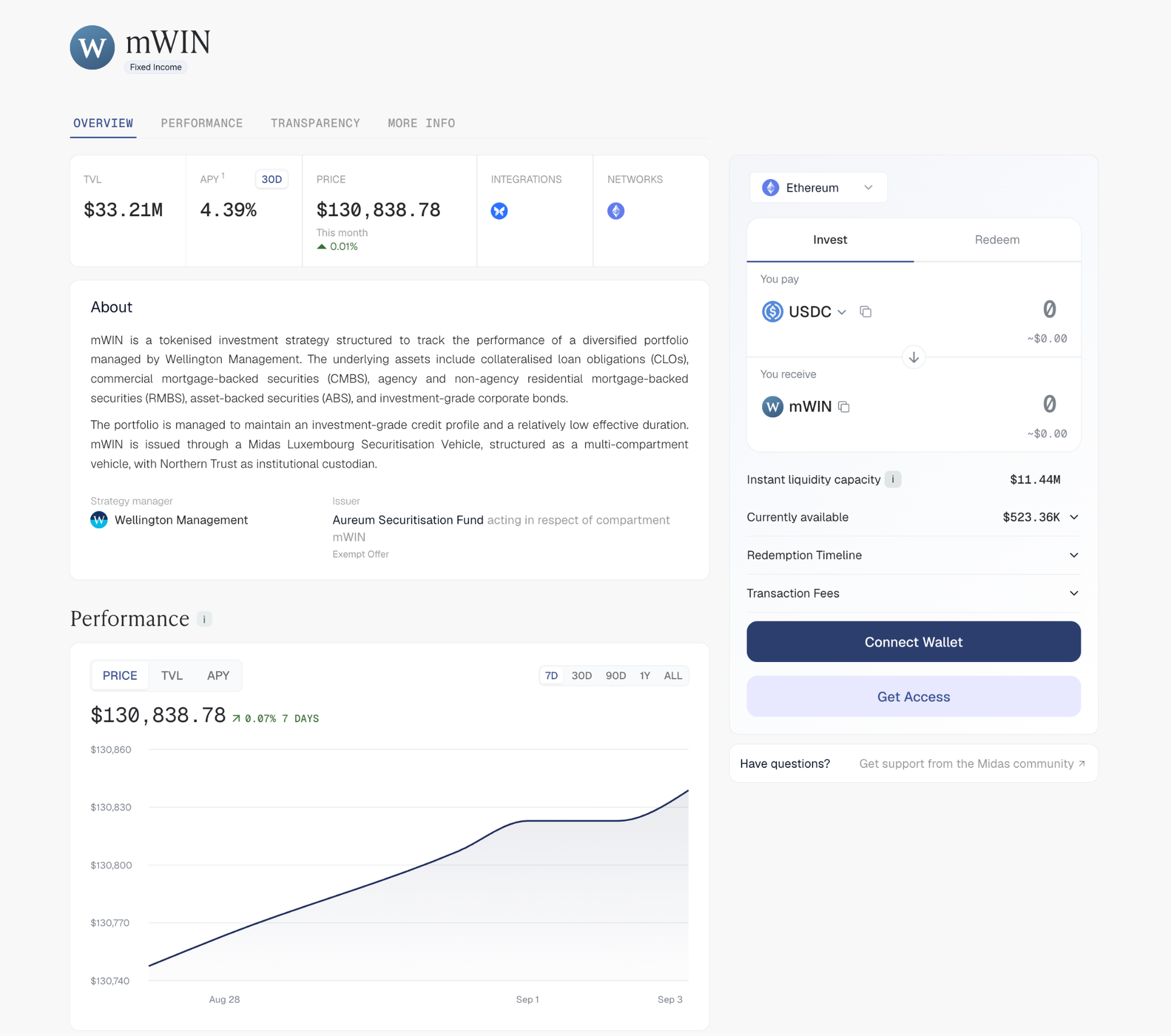
Active management is what separates mWIN from most fixed income onchain. Most existing structures sit static, mirroring a fixed basket or wrapping a single underlying fixed income sector. Wellington adjusts the portfolio's exposures on an ongoing basis in response to macroeconomic data, liquidity conditions and security-level fundamentals, and can rotate across sectors as conditions change. That is what allows the strategy to navigate different market environments rather than sit fixed through them, and it is the difference between a static claim on a basket and an allocation a treasury can hold across cycles.
mWIN is issued through a Luxembourg Securitisation Vehicle, from a single bankruptcy-remote compartment that holds the strategy directly. The compartment is legally segregated from every other compartment and from Midas itself, owned through an orphan structure separated from Midas and any other stakeholder. Northern Trust holds the offchain leg in segregated accounts securities, asset-backed securities and provides independent daily pricing, which forms the basis for the NAV. Token holder rights are enforceable and backed by the structure, not cosmetic.
Learn more about mWIN on its product page or the official announcement from August 5th.
Built to Work Onchain: Redemptions & Composability
A reserve asset only works for a treasury if it stays liquid. mWIN is built to stay liquid while it is held. Redemptions run through the Midas Open Liquidity Architecture, which gives a treasury two routes to choose between.
- Standard redemption is the default, and it is fee-free. It follows the natural settlement timeline of the underlying assets: requests are processed for mWIN on a T+1/T/+2 basis. Unlike the instant route, it is not constrained by available liquidity capacity. For the large majority of treasury flows, this is all that is needed.
- Instant redemption settles immediately into a stablecoin such as USDC, in a single transaction, for when a treasury needs to move faster. It draws on a liquidity pool, so it is subject to available capacity and carries a fixed redemption fee. That pool is sourced in a defined order, starting with the lowest-cost layer: an internal liquidity sleeve for everyday flow, Midas Staked Liquidity as the core layer that provides instant liquidity without cash drag, and an external network of market makers as a secondary-market backstop.
A treasury does not have to redeem at all. Sentora brings mWIN into DeFi as collateral on Morpho, curating a dedicated market in which PayPal's PYUSD serves as the loan asset and mWIN is accepted as collateral, with predefined collateral and risk parameters monitored on an ongoing basis. Listings on Aave's Horizon Market and RWA Hub follow. In practice this works like a repo: a treasury can borrow against its mWIN position to raise liquidity when it is needed, without selling the reserve.
A Reserve Asset for the Long Horizon
So a treasury reserve is rarely held in a single product. Most treasuries spread capital across different products, maturities and currencies, with operating capital kept at the front of the curve, the money a protocol might spend soon. mWIN is a strong addition to that portfolio for the runway, the reserves measured in years, where a modest step out into actively managed investment-grade credit compounds into a meaningful difference over a treasury's life. Until now, that kind of exposure has been hard to hold onchain.
Because mWIN stays liquid and composable onchain, moving further out the curve does not mean giving up access. Reserves remain redeemable and usable as collateral throughout, with a strategy of institutional standing behind them. For the long-dated part of a treasury, that means an asset built for the horizon it is actually held over, without sacrificing the liquidity a reserve exists to provide.
Access mWIN
Investors can access mWIN directly on Midas’ website, or gain composable exposure through Sentora's Morpho vault.
About Midas
Midas is a platform for composable onchain investment products. It gives investors exposure to institutional strategies, run by professional strategy managers, through its performance-linked mTokens. These tokens offer full transparency, instant redemptions, and native composability across DeFi.
Founded in 2024 by Dennis Dinkelmeyer (formerly Goldman Sachs), Fabrice Grinda (FJ Labs), and Romain Bourgois (formerly Ondo Finance), Midas is backed by leading investors including RRE, Creandum, Framework Ventures, HV Capital, Ledger Cathay and Coinbase Ventures. The company recently secured $50M in Series A funding, building on a track record that includes over $4B in asset issuance and $48M in yield paid out to date.