Introducing mWIN: Bringing Institutional Credit Onchain with Wellington Management
Midas is partnering with Wellington Management to launch mWIN, an institutional credit strategy, issued natively through a Luxembourg Securitisation Vehicle. mWIN is a tokenised investment strategy linked to an actively managed, multi-sector, fixed income portfolio purpose-built for onchain composability with defined risk parameters, including duration, spread duration and credit quality. Wellington Management acts as strategy manager, Northern Trust as institutional custodian. On day one, Sentora brings mWIN into DeFi as collateral on Morpho – with more integrations such as Aave's Horizon Market and RWA Hub coming soon.
Why This Matters
It is the first time an institutional investment manager of this scale has brought a diversified credit strategy to market through native onchain issuance. mWIN gives investors exposure to a diversified, investment-grade fixed income portfolio that is actively managed across market cycles, and built from the ground up to work as onchain collateral: deeply liquid, composable, and usable in lending and leveraged strategies from day one.
Active management is a large part of what sets mWIN apart. Most RWAs onchain are static, tracking a fixed basket or wrapping a single underlying. mWIN is different: Wellington adjusts the portfolio's exposures on an ongoing basis in response to macroeconomic data, liquidity conditions, and security-level fundamentals, and can rotate across sectors as conditions change. That dynamic management is what allows the strategy to navigate different market environments, rather than sitting fixed through them.
Inside the Strategy
mWIN provides exposure to a diversified portfolio spanning some of the most liquid asset classes within public fixed income. The underlying assets include collateralised loan obligations (CLOs), commercial mortgage-backed securities (CMBS), agency and non-agency residential mortgage-backed securities (RMBS), asset-backed securities (ABS), and investment-grade corporate bonds.
The portfolio is actively managed, within defined thresholds for effective duration and average credit quality. The result is exposure to the return profile of fixed income, with the transparency and liquidity of onchain settlement.
mWIN improves on how credit has previously come onchain, on transparency, liquidity and cost. In many existing structures, the token sits several steps removed from the strategy, through stacked wrappers that each add cost. mWIN is issued from a single, bankruptcy-remote compartment that holds the strategy directly, a segregated structure that reduces the intermediating layers, and the costs they carry, between the investor and the portfolio.
Learn more about mWIN here.
Wellington Management as Strategy Manager
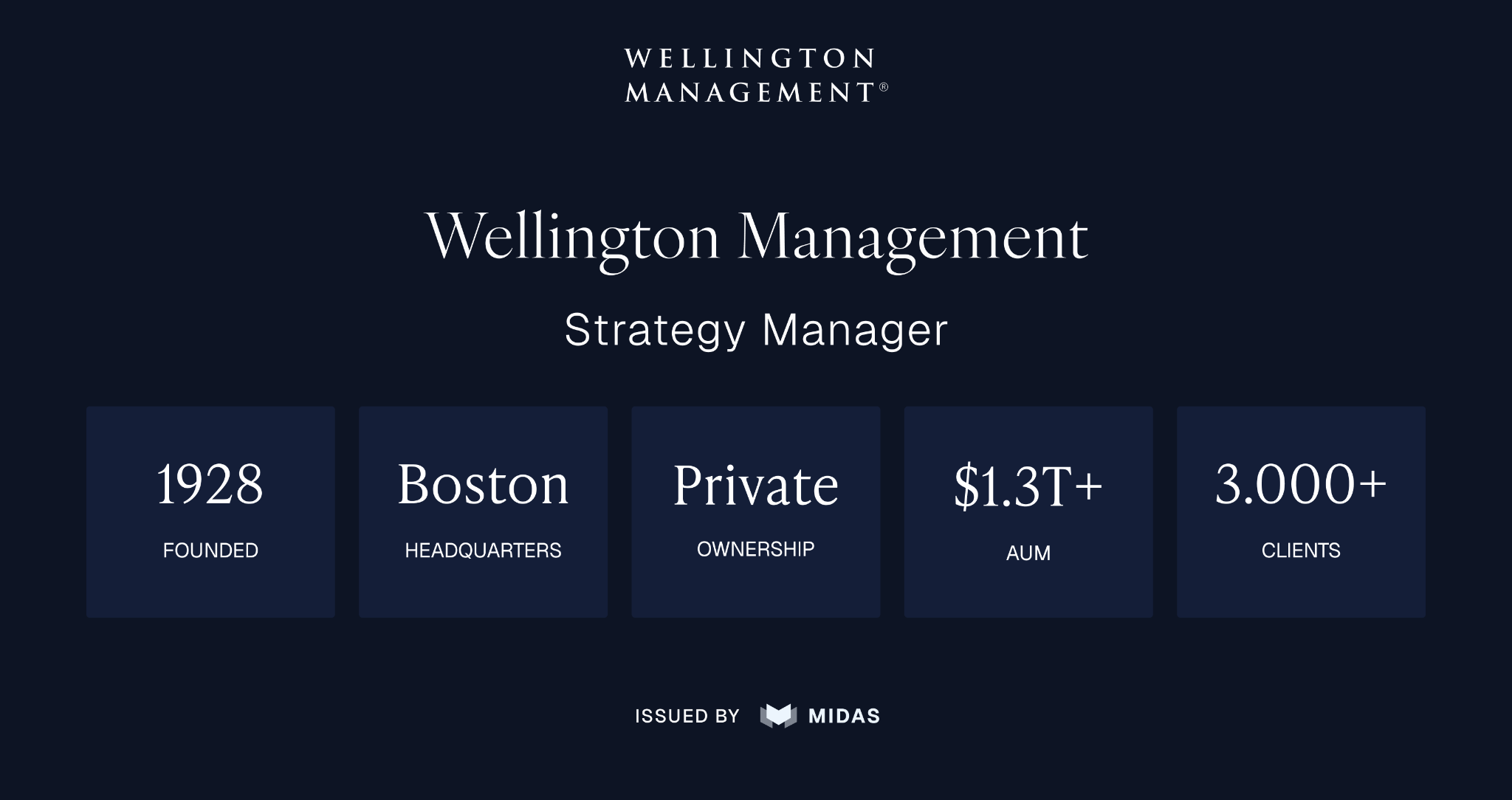
Wellington Management is one of the largest investment management firms in the world. Founded in Boston in 1928, the firm is privately held and partner-owned, with offices across North America, Europe, and Asia-Pacific. Wellington manages over USD 1.3 trillion in assets across fixed income, equities, multi-asset, and alternative strategies, on behalf of thousands of institutional clients globally, including pension funds, sovereign wealth funds, insurers, and endowments.
The firm's credit business is among the most established in the industry, with multi-decade experience across leveraged credit, structured products, and corporate fixed income.
Wellington is acting as strategy manager for mWIN under an investment management mandate, with responsibility for portfolio construction and ongoing management of the underlying strategy within the compartment. This is a landmark moment for onchain finance: With a manager of Wellington's stature, Midas is setting the standard for how institutional strategies are issued onchain as securities.

Sentora: Composability at Launch
Sentora, one of the largest DeFi vault curators and a leading strategy and risk partner behind high-profile Earn programs such as Kraken DeFi Earn and Deel’s stablecoin reward feature, integrates mWIN as collateral on Morpho. With more than $2B in TVL, Sentora brings DeFi depth, institutional distribution, and risk infrastructure to the mWIN launch. Sentora's role is to bring mWIN into DeFi as collateral. Ahead of launch, Sentora assessed the token against the liquidity and risk standards required for use in onchain lending markets, so that mWIN would be usable as collateral from day one.
At launch, Sentora will curate a dedicated Morpho lending market in which PayPal's PYUSD stablecoin serves as the loan asset and mWIN is accepted as collateral. Sentora implements and monitors the market's predefined collateral and risk parameters. The integration is intended as the first step in a broader strategic partnership, bringing tokenised institutional credit into DeFi's productive capital layer.
The Luxembourg Securitisation Platform
Luxembourg is the leading jurisdiction for securitisation globally. The Securitisation Law of 2004 provides one of the most developed legal frameworks for structured products in the world, and is the reason a substantial share of securitisation activity is domiciled there.
mWIN is issued through a Luxembourg Securitisation Vehicle, structured as a multi-compartment vehicle. Each compartment is a legally segregated pool of assets and liabilities, with statutory bankruptcy remoteness from every other compartment and from Midas itself. Investors in one compartment have no exposure to the assets, liabilities, or performance of any other. The structure is owned by an Orphan trust totally separated from the activity of Midas or any other stakeholder, providing best in class protections for investors.
This structure maps cleanly to onchain issuance: one compartment, one strategy, one mToken. Each product sits inside its own ringfenced compartment, with its own assets, its own strategy manager, and its own redemption mechanics.
The offchain leg of the structure is held with Northern Trust as institutional custodian, with segregated accounts per compartment that mirror the onchain segregation. Northern Trust also provides independent daily pricing of the underlying assets, which forms the basis for NAV calculation.
Instant Liquidity Through the Open Liquidity Architecture
An investment product like mWIN only works as onchain collateral if holders can exit reliably. mWIN redemptions run through the Midas Open Liquidity Architecture, a multi-layer system built to deliver instant, atomic redemptions. Liquidity is drawn from three sources in a defined order, starting with the lowest-cost layer and moving to the next only as each is exhausted. The result is a structured waterfall that keeps the cost of exit low for the holder.
- Internal Liquidity Sleeve. A baseline buffer held within the portfolio, in instruments such as USDC or mTBILL, that services everyday redemption flow. It is efficient for smaller redemptions and sits as the first and shallowest layer, since capital held in the sleeve introduces cash drag at scale.
- Midas Staked Liquidity (MSL). The core of the architecture, and the layer that provides instant liquidity without cash drag. MSL is a dedicated facility held outside the mToken's collateral, so it does not dilute the underlying strategy.
- OTC Liquidator Network. An external backstop that operates as a secondary-market exit rather than a redemption. Third-party market makers and RFQ platforms bid to buy mWIN directly, winning flow only when their quote is the most competitive, adding deep bilateral liquidity beyond the first two layers.
Alongside instant redemption, standard redemption remains available fee-free, following the underlying strategy's natural settlement timeline. For mWIN as onchain collateral, the practical result is optionality: holders can redeem instantly through the internal liquidity sleeve or MSL, exit via the OTC network, or use standard redemption when immediacy is not required, taking whichever route prices most competitively at the time. Learn more in our docs.
Inside The Midas Architecture Supporting Over $2B Total Assets Minted
mWIN sits inside the Midas institutional architecture: a stack that underpins every onchain investment product, has facilitated over $2B in asset issuance, and is backed by a $500k bug bounty programme. It is organised across three layers:
- Liquidity. Midas Staked Liquidity and the Open Liquidity Architecture, which provides the mechanics for secondary liquidity without compromising the primary issuance structure.
- Transparency. The Midas Attestation Engine, which produces independent, cryptographically verifiable attestations of compartment composition and reporting. The engine is built with Chainlink CRE, LlamaRisk, vLayer, and Canary as independent verifiers.
- Composability. mTokens are natively compatible with DeFi protocols, usable as collateral on lending markets, in liquidity pools, and across onchain strategies.
Learn more about this architecture on the Midas website or the Midas documentation.
Live on Ethereum, with Monad to Follow
mWIN is live today on Ethereum mainnet, with subscriptions available in USDC and PYUSD. Additionally, mWIN is coming soon to Monad, extending the same product to a second chain without changing its issuance structure or composability. Monad is a high-performance, EVM-compatible Layer 1 blockchain designed for parallel execution and high throughput. On Monad, subscriptions will also be available in AUSD, Agora's US dollar stablecoin, backed by cash and short-term US Treasury bills, with reserves managed by VanEck and custodied at State Street.
Access mWIN
Investors can access mWIN directly on Midas’ website, or gain composable exposure through Sentora's Morpho vault.
About Midas
Midas is a platform for composable onchain investment products. It gives investors exposure to institutional strategies, run by professional strategy managers, through its performance-linked mTokens. These tokens offer full transparency, instant redemptions, and native composability across DeFi.
Founded in 2024 by Dennis Dinkelmeyer (formerly Goldman Sachs), Fabrice Grinda (FJ Labs), and Romain Bourgois (formerly Ondo Finance), Midas is backed by leading investors including RRE, Creandum, Framework Ventures, HV Capital, Ledger Cathay and Coinbase Ventures. The company recently secured $50M in Series A funding, building on a track record that includes over $2B in asset issuance and $46M in yield paid out to date.