What Are Onchain Investment Products?

Onchain finance is maturing. What started as lending protocols and liquidity pools is evolving into something closer to a full financial system, one where real investment products can be issued, distributed, and redeemed entirely onchain. But for that to work, the products themselves need to be built properly: with defined investor rights, transparent risk disclosure, and a legal framework that holds up under scrutiny.
That is exactly what Onchain Investment Products are. They are security tokens, issued under offering documentation that define investor rights, they carry real risk, and they can fluctuate in price, because their value moves with the performance of the underlying. That makes them fundamentally different from an asset-pegged token(stablecoins) or a smart contract that pools deposits (vaults). And the distinction matters, because the categories describe fundamentally different things with different risk profiles, different legal standing, and different implications for everyone involved.
What Are Onchain Investment Products?
In traditional finance, an investment product is an instrument with return expectations, clearly defined investor rights, and issuance under a regulatory framework. It could be a fund unit, a structured note, a certificate, or any number of other forms. The common thread is that the investor knows what they hold, what the risks are, and what rights they have if something goes wrong.
An onchain investment product brings that same structure to onchain markets. It is a tokenised financial instrument, issued as a security token with robust legal structuring, that gives investors exposure to a professionally managed strategy. The token's value can go up or down depending on how the underlying performs. Investor rights are defined in offering documentation. Risk is disclosed, not hidden.
At Midas, these instruments are called mTokens. They are issued as security tokens under offering documentation that defines investor rights, key risk factors, and product-specific terms. Each product is managed by an appointed strategy manager, with ongoing oversight of risk parameters and performance.
This is the critical point: the price is not pegged. It reflects actual performance. If the strategy does well, the NAV goes up. If market conditions shift or a strategy underperforms, the NAV goes down. That is not a bug. That is what makes it a financial instrument and investment product. Risk is inherent to any investment, and it is the very thing that enables returns. The difference is whether that risk is disclosed, managed, and understood by the investor, or whether it is hidden behind a peg or an interface. mTokens make the trade-off explicit: investors accept defined risk in exchange for exposure to professionally managed strategies, with full transparency into what they hold and how it performs.
Midas’ mTokens are issued as ERC-20 tokens, which are natively composable across DeFi, meaning they can be used as collateral on lending markets, deployed in liquidity pools, and integrated across protocols without wrapping, bridging, or additional infrastructure.
What Are Stablecoins?
A stablecoin is a token designed to maintain a stable value, typically pegged 1:1 to a fiat currency like the US dollar. The most widely used stablecoins (USDC, USDT, USDS) achieve this peg through reserves, overcollateralisation, or algorithmic mechanisms.
The defining feature of a stablecoin is that its price should not move. The entire point is stability: one token equals one dollar (or whatever the reference currency is), regardless of what happens in the broader market.
Stablecoins are used for payments, settlement, and as a unit of account across DeFi. They are not designed to generate yield. They are not structured to track an investment strategy. And they are not, in most jurisdictions, classified as securities.
Yield-bearing stablecoins are a newer category that blurs this picture significantly. Some maintain a dollar peg while passing through yield to holders, but the source of that yield is often far more complex than it appears. In some cases, the yield is generated from actively managed strategies, including basis trades involving leveraged positions across spot and derivatives markets. That is not passive reserve management. It is an active financial strategy packaged inside a stablecoin wrapper, designed in part to sidestep securities regulation.
This is where the distinction with onchain investment products matters most. A stablecoin, by design, aims to maintain a $1 peg. That peg constrains the level of investment and duration risk the product can take, which in turn limits the scope of returns it can offer. Different designs exist in the market, and some push further than others, but the structural constraint remains: the peg must hold. If it does not, holders face a loss scenario that the product was never designed to handle. An onchain investment product operates without that constraint. There is no peg to maintain. The value moves with the strategy, the risks are disclosed in offering documentation, and the investor understands from the outset that performance can go in either direction.
What Are Vaults?
In DeFi, a vault is a smart contract that pools user deposits and deploys them into yield-generating strategies. Vaults are a core piece of DeFi infrastructure, and they serve an important purpose in the ecosystem.
The key characteristics of a vault:
- The user deposits assets into a smart contract.
- The vault curator decides how and where to allocate those assets.
- Returns are generated from onchain activities (lending, liquidity provision, reward farming).
- There is typically no formal legal wrapper. The relationship between the depositor and the vault is governed by smart contract logic, not by securities law.
Vaults serve an important purpose in DeFi. But they are infrastructure, not financial instruments. They do not come with market transparency requirements, formally defined investor rights or an issuer legally accountable under securities offering documentation And if something goes wrong, the depositor's recourse is limited to whatever the smart contract allows.
Some lending vaults operate under strict, rule-based constraints. Because of the way these systems are architected (and the specific frameworks governing how curators act) the managers have limited access to funds. Every parameter is visible, changes have timelocks etc. This reduces risk by design governed by smart contracts.
On the other hand a lot of vault platforms now offer actively managed strategies, often market-neutral. In substance, the activity increasingly resembles that of a hedge fund.
Actively managed vaults without a proper legal setup place both parties in jeopardy. Without formal legal terms, investors take on significant counterparty risk that the smart contract alone cannot mitigate. Furthermore, managers of these active strategies are likely engaging in regulated financial activity. This means the manager is legally exposed, while investors may have no clearly defined contractual rights and may be left to rely on mandatory statutory protections that can be uncertain, difficult, or costly to enforce in practice.
Why They Are Not the Same
The confusion between these categories is understandable. Onchain investment products can look a lot like yield-bearing stablecoins. Vaults issue tokens that behave like fund shares. Some onchain investment products track stablecoin-denominated strategies. The labels overlap, the interfaces look similar, and the marketing often deliberately blurs the lines because clearer categories would force harder questions about risk, regulation, and investor protection.
But the differences are structural, not cosmetic.
- Stablecoins are designed not to move in price. Yield-bearing stablecoins pass through returns from reserve deployment, but still aim to hold their peg, with limited visibility into what generates the yield or what happens when positions underperform.
- Vaults deploy capital at a curator's discretion, governed by smart contract logic. There is no offering documentation, no contractual investor rights, and no legal recourse beyond what the code allows. Actively managed vaults increasingly resemble hedge funds, but without the legal framework that would normally apply.
- Onchain investment products are securities, issued with robust legal structuring, defined investor rights, and independent onchain attestation. Their value can go up or down. They carry real risk, and that risk is disclosed. If there is a drawdown, all holders face the same conditions. There is no peg to break and no bank run.
At Midas, the distinction is clear in the product architecture. When you hold mHYPER, for example, you hold a tokenised investment product that tracks the performance of a market-neutral stablecoin strategy managed by Hyperithm. You do not have direct exposure to any vault. You hold a certificate whose NAV reflects the strategy's performance, published onchain and verified independently through the Midas Attestation Engine.
It Does Not Only Go Up: Why Risks Are a Feature, Not a Flaw
One of the most common misconceptions in onchain finance is that yield products should only go up. Stablecoins reinforce this expectation by design: the price holds its peg, and any yield feels like money on top. Vaults trend in the same direction, with share prices that accrue yield over time and rarely surface the underlying risks in a way that the depositor can meaningfully evaluate. Some protocols go further, marketing "sustainable yields" and "optimised returns" without adequately disclosing what could go wrong.
Onchain investment products work differently. Their NAV can go up and down, because that is what investment products do. The value reflects the real performance of a real strategy, and real strategies carry real risk: market risk, execution risk, counterparty risk, operational risk. That is not a design flaw. It is the mechanism that enables returns in the first place. Risk and return are inseparable. Any product that claims to offer yield without risk is either mispricing that risk or hiding it.
This also changes what happens during a drawdown. When a stablecoin's reserves suffer a loss, the peg comes under pressure, and holders rush to redeem before the backing runs out. That dynamic, a bank run, creates a first-mover advantage where early redeemers exit at par and late redeemers absorb disproportionate losses. An onchain investment product does not work this way. If the underlying strategy draws down, the NAV reflects it. All holders face the same conditions at the same time. There is no race to the exit, no liquidation cascade, and no structural incentive to panic. The product absorbs the drawdown transparently and equally, exactly as securities would in traditional finance.
Midas takes this head-on. Every mToken product page and offering document makes clear that the NAV can increase or potentially decrease in value. The full risk profile is disclosed, the strategy is defined, and the investor knows what they are exposed to before they commit capital. The strategies tracked by mTokens have exposure to DeFi protocols, market conditions, liquidity dynamics, and operational factors. Market downturns, volatility, execution issues, or changes in DeFi protocol terms can all impact performance, and none of that is obscured.
This transparency is what separates an onchain investment product from a yield-bearing stablecoin that bundles undisclosed risk behind a dollar peg, or a vault that deploys capital at a curator's discretion without formal accountability. Risks exist in all three categories. The question is whether those risks are disclosed, managed, and understood by the investor, or whether they are hidden until something breaks.
With mTokens, investors know what they are buying: a security token that tracks a professionally managed strategy, with defined rights, independent attestation, and the understanding that performance reflects real-world conditions. Not a number that only goes up.
What Sits Behind an mTOKEN: Legal, Operational, and Technical
Tokenisation is not just putting a token on a blockchain. Doing it properly requires solving four distinct problems: legal structure, smart contract infrastructure for minting and redemption, liquidity architecture, and transparency. Most tokenised products solve one or two of these. Midas is built to address all four, and each one is a distinct layer of the stack.
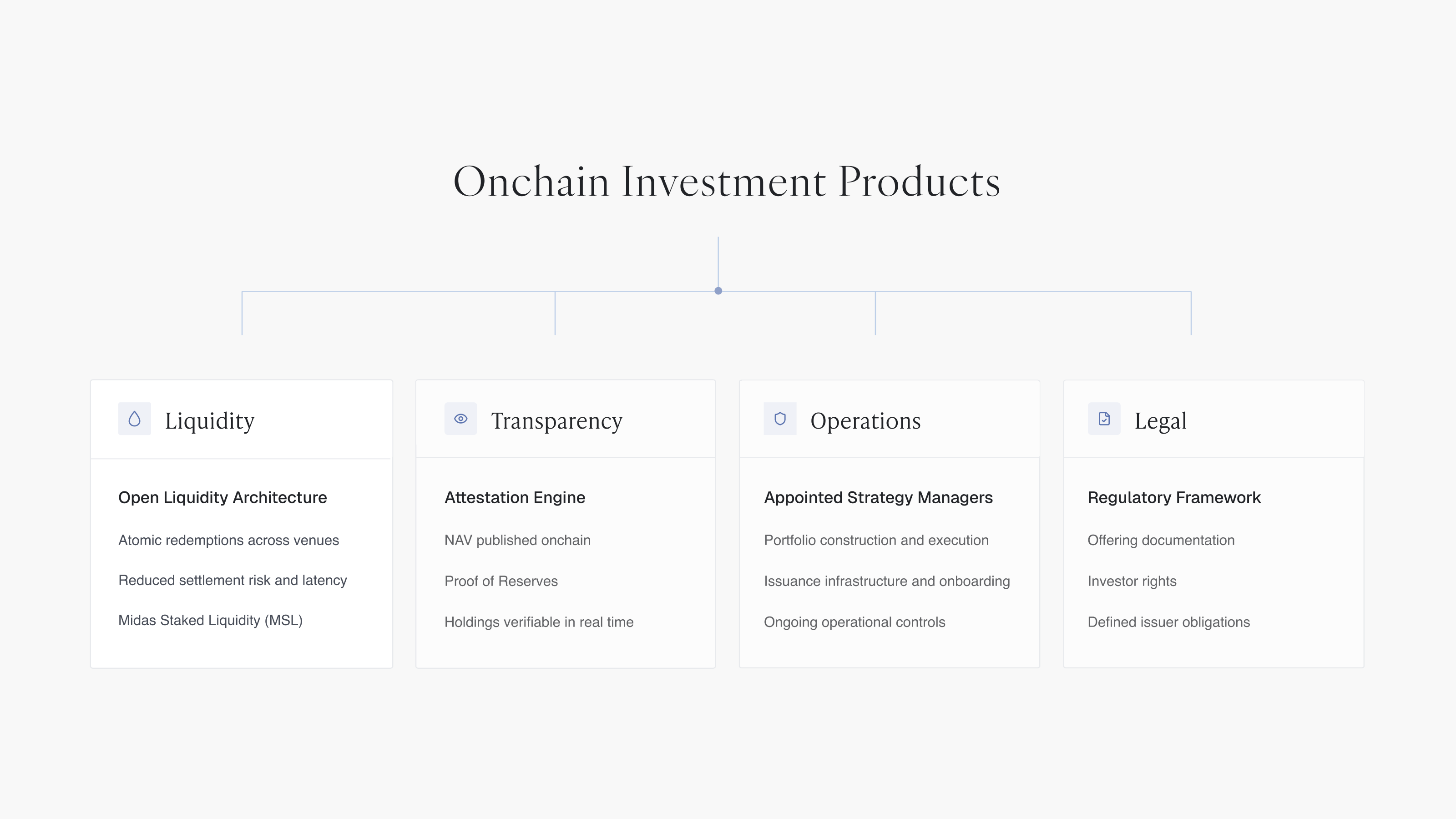
Legal. mTokens are structured as blockchain-based certificates either through through Midas' Luxembourg securitisation vehicle (which provides statutory asset segregation and bankruptcy remoteness under the Luxembourg Securitisation Law), or under a base prospectus approved by the Liechtenstein Financial Market Authority (Finanzmarktaufsicht Liechtenstein, FMA). In both cases, the offering documentation sets out investor rights, key risk factors, issuer obligations, and product-specific terms. Learn more here.
Operations. Each product has an appointed strategy manager responsible for the underlying reference portfolio. Midas provides the issuance infrastructure, investor onboarding, and ongoing operational controls. The strategy manager handles portfolio construction, risk management, and execution. Learn more here.
Transparency. The Midas Attestation Engine converts key financial data (NAV, Proof of Reserves, portfolio holdings) into cryptographically signed attestations published onchain. Built with Chainlink, LlamaRisk, vLayer, and Canary, the engine provides an independent trust layer on top of Midas' existing dashboards. Attestations are stored on IPFS and can be consumed programmatically by DeFi protocols, institutional investors, or risk frameworks. Learn more here.
Liquidity. Midas' Open Liquidity Architecture, with MSL (Midas Staked Liquidity) at its core, enables atomic redemptions with no cash drag and reduced settlement risk. Most tokenised products require unwinding positions and waiting for settlement. Learn more here.
None of this exists in a standard DeFi vault. Vaults have smart contracts and curator logic. An mToken has smart contracts, a legal wrapper, independent attestation, and dedicated liquidity infrastructure.
Explore mTokens
Onchain investment products are built for investors who want exposure to professionally managed strategies with defined rights, transparent risk disclosure, and full onchain composability.
Explore the full range of mTokens, or read our documentation to understand the structure, risks, and investor rights in detail.
About Midas
Midas is a platform for composable onchain investment products. It gives investors exposure to institutional strategies, run by professional strategy managers, through its performance-linked mTokens. These tokens offer full transparency, instant redemptions, and native composability across DeFi.
Founded in 2024, the company secured $50M in Series A funding, building on a track record that includes over $2B in asset issuance and $43M in yield paid out to date.