Introducing Midas Staked Liquidity (MSL): Instant, Atomic Liquidity for Tokenised Assets
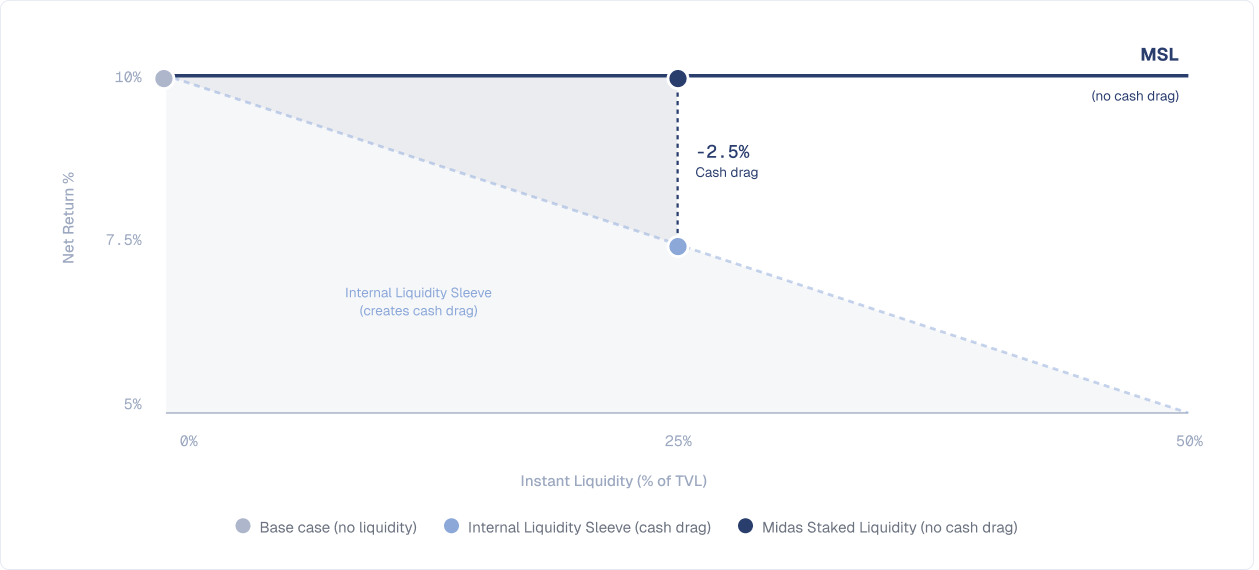
Every tokenised asset faces the same structural trap: to support instant liquidity, protocols either bleed yield through idle cash reserves, or hand control to market makers who price in settlement delays and counterparty risk at rates that are prohibitively expensive. Neither option is acceptable at scale.
By introducing its Open Liquidity Architecture, with Midas Staked Liquidity (MSL) at its core, Midas introduces a solution: a dedicated liquidity layer that provides instant, atomic redemptions for tokenised assets without cash drag, without settlement risk, and without third-party dependency. To seed the facility, Midas has committed up to $40 million.
The Problem
Liquidity has always come at a price: For a tokenised asset to function in onchain money markets, such as lending loops or collateralised borrowing, it needs to support instant redemptions. When utilisation spikes or a user needs to exit quickly, the protocol must absorb that demand without delay.
Today, protocols manage this through two mechanisms, both structurally expensive:
- Internal cash drag. A portion of the portfolio sits in idle stablecoins. The buffer works, but it continuously dilutes yield. Capital in a liquidity reserve is capital not earning a return.
- Third-party market makers. External providers price in the risks they're taking. Settlement delays, counterparty exposure, and unpredictable demand mean hurdle rates as high as 30% annualised, often translating to a 10% NAV discount at exit. And this liquidity tends to disappear precisely when market conditions are most stressed.
Neither solution scales. Neither is equitable to the end user.
The Open Liquidity Architecture
Midas utilizes a multi-layered liquidity architecture that integrates an internal liquidity sleeve, Midas Staked Liquidity (MSL), and an OTC liquidator network. All three sources compete on fees for every redemption request. The lowest-cost source is drawn first. This comprehensive design provides robust, instant access to capital for our onchain investment products.
Crucially, this architecture is designed so that all forms of liquidity actively compete on fees. By pitting these sources against one another, competing market forces naturally drive down the cost of execution for the end user.
- Layer 1: Internal Liquidity Sleeve. A baseline buffer held within the product portfolio that enables immediate atomic redemptions for everyday flow. Efficient for small redemptions, but introduces cash drag at scale.
- Layer 2: Midas Staked Liquidity (MSL). As MSL is accounted external to the mTokens collateral, it provides instant USDC without diluting the underlying strategy's yield (i.e. no cash drag).
- Layer 3: OTC Liquidator Network. An external backstop. Third-party market makers and RFQ (Request For Quote) platforms plug directly into the same pathways and compete for execution on price, winning flow only when the quote is competitive. They provide an additional layer of deep, bilateral liquidity.
This architecture ensures Midas assets support all possible liquidity sources. The competitive dynamic across all three layers is designed to continuously reduce the cost of liquidity for users over time.
The Core Layer: Midas Staked Liquidity (MSL)
Midas Staked Liquidity (MSL) provides deep, instant liquidity without introducing settlement risk or inducing cash drag. Because MSL operates as a dedicated facility outside the underlying mToken's strategy, it directly increases the asset's liquidity profile with zero cash drag and mitigates settlement risk.
MSL settles redemptions using a "redemption holdback", a structural design that scales without counterparty risk. Instead of relying on the steep discounts mandated by market makers, MSL provides instant liquidity for the bulk of the redemption based on an estimated price, but safely delays the final fraction of the payout until the underlying asset officially clears. This protects the liquidity provider from settlement risk. Once the asset clears at its traditional settlement venue, MSL ensures an equitable distribution of the withheld capital back to the user.
This mechanism mirrors an "audit holdback" used by fund administrators in traditional finance.
How MSL Works
When an instant redemption request is made, the liquidity source is selected based on the lowest cost available. MSL executes when it offers the most efficient execution:
01. Loan and payout. MSL extends a USDC credit facility to the asset's compartment. The user is paid out immediately and their tokens are burned.
02. Collateral redemption. The asset compartment simultaneously initiates a standard redemption of an equivalent amount of its underlying fund shares at the settlement venue.
03. Repayment. Once the underlying shares settle, the compartment fully repays the MSL loan. The withheld fraction is returned to the user at the equitable clearing price.
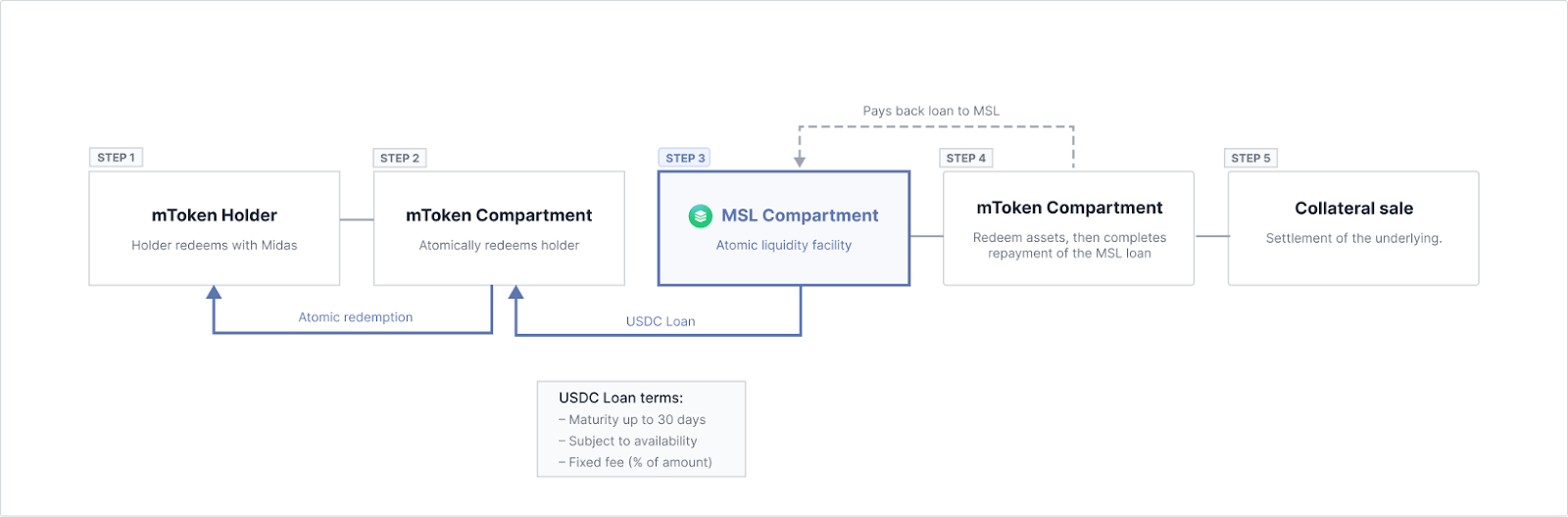
The user exits cleanly at an equitable price. The underlying asset settles on its normal schedule. MSL bridges the gap between the two.
MSL as a Productive Asset
Capital within MSL does not sit idle. As a base layer of yield, funds are deployed into investment-grade instruments including the Prime Lending markets and U.S. Treasury bills, earning the risk-free rate while remaining available for atomic redemption on demand.
On top of that base yield, MSL earns a redemption fee each time capital is drawn. This fee compensates the facility for capital utilisation and the duration of each settlement window. For each supported asset, the fee is priced to target Secured Overnight Financing Rate (SOFR) plus a risk premium.
The Vision
The global market for tokenisable assets runs into the hundreds of billions, and MSL is designed to serve as its foundational liquidity layer.
The architecture enables any asset, whether a vault, fund, ETF, or stock, to come onchain by leveraging the deep liquidity of its native market. By removing settlement risk as a structural barrier, Midas is building the infrastructure that makes that possible.
About Midas
Midas is a platform for composable onchain investment products. It enables strategy managers to turn institutional strategies into compliant tokens that offer investors full transparency, instant redemptions, and native composability across DeFi protocols such as Morpho and Pendle.
Founded in 2024 by Dennis Dinkelmeyer (formerly Goldman Sachs), Fabrice Grinda (FJ Labs), and Romain Bourgois (formerly Ondo Finance), Midas is backed by leading investors including RRE, Creandum, Framework Ventures, HV Capital, Ledger Cathay and Coinbase Ventures.